

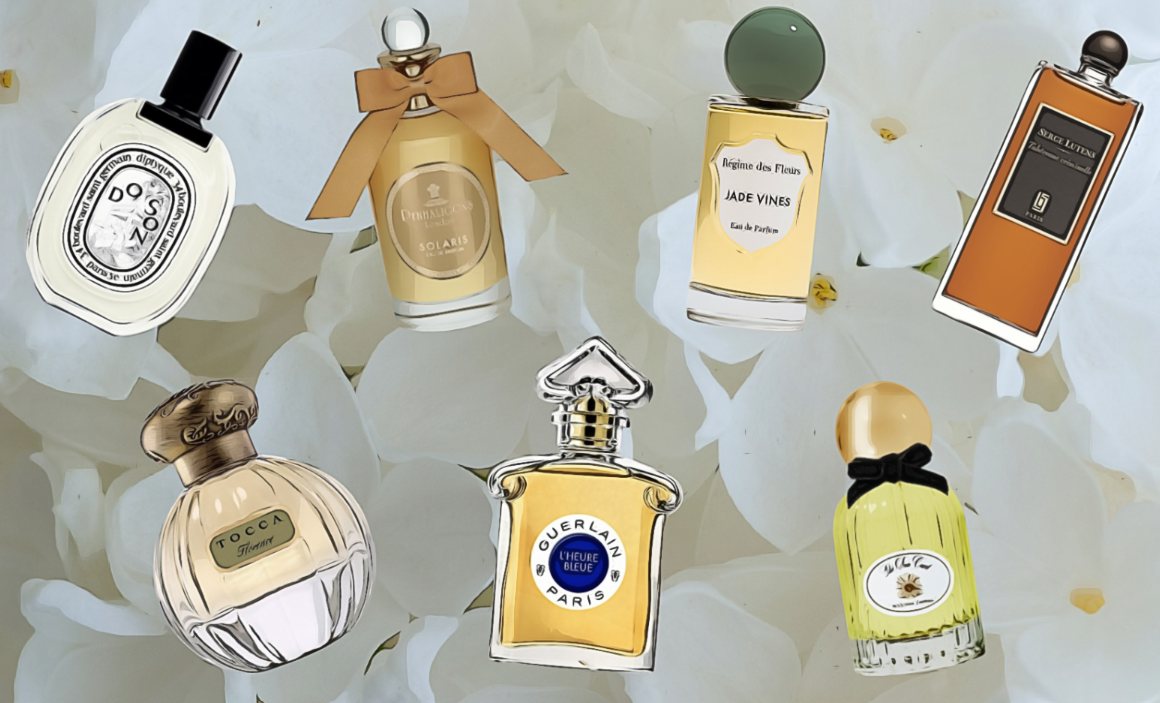
“I don’t like floral perfumes,” some people like to smugly assert, before proclaiming they favour the timeless elegance of Chanel No. 5 or the breezy sophistication of Diptyque Do Son. Of course, those who make such asinine statements are typically referring to those obvious florals. You know — rose, peony, violet, lavender, iris, heliotrope…often paired with lashes of red fruits and underscored by sweet musks. But it would be remiss to dismiss the most varied fragrance category based on one’s experiences with a rather limited bouquet.
White floral fragrances have an opulent, narcotic character that’s entirely different to their pink, red, and purple counterparts. While the white floral subcategory is an olfactorily diverse one, each of its members is united by the presence of indole. An organic compound naturally present in many white flowers, indole is responsible for lending a rich, complex depth to white floral fragrances. The presence of indole is what precludes white floral fragrances from falling into the trap of being overly sweet or a ‘one-dimensional’ floral perfume.
Indole is often described as “dirty, fecal, and animalic,” and while that’s somewhat true, it’s not the whole story. In its pure, unadulterated form, indole smells like mothballs, decaying florals, or even wet dog, possessing a stale, pungent, and even suffocating quality. Although that doesn’t sound like a recipe for a good perfume, indole experiences a significant change when diluted, with its suffocating mothballs/wet dog quality dissipating and making way for radiant florals with a heady, animalic undertone. This indolic balance of sweet floral and carnal ‘dirty’ notes is what makes white floral fragrances so sensual and addictive.

The main white florals used in fragrance
The white floral fragrance subcategory is a multivaried one. To ensure you don’t mix up your jasmine with your tuberose—and know exactly what the difference between orange blossom and neroli is—we’ve put together a guide on the six main white florals used in fragrances and perfumes. Plus, the best scents to try from each flower.
1. Jasmine
The queen of white florals, jasmine can be described as anything from soft, sweet, and innocent to narcotic, cloying, sensual, exotic, and intense. There are well over a hundred varieties of jasmine grown around the world, but the two types most often used in perfumery are jasmine grandiflorum (Jasminum grandiflorum) and jasmine sambac (Jasminum sambac).
Jasmine grandiflorum is grown in both the east and west, sourced from Italy, Egypt, India, and the Grasse region of France. It’s known for its refined scent profile, with rich, opulent floral notes with heady undertones of leather, liqueur, creamy almond milk, and animalic notes. Of the two types of jasmine, jasmine grandiflorum is typically considered the most indolic.
Meanwhile, jasmine sambac is predominantly grown in India and has a brighter, more modern scent profile, characterised by green, fresh, spicy, musky, and tea-like notes. This is the variety of jasmine used within many South Asian temples, as well as in jasmine tea.
With the ability to flit from innocent and unassuming to sensual, dark, and seductive, jasmine is used in many feminine fragrances. Jasmine adds to the ladylike, powdery, and undeniably elegant character of Guerlain’s L’Heure Bleue and Mitsouko, while the addictive indolic quality of jasmine is celebrated in Jean Patou’s Joy. For something darker yet undeniably sexy, Serge Lutens Sarrasins pairs narcotic jasmine with spicy, leathery notes, while Etat Libre D’orange Jasmin Et Cigarette teams green jasmine with the sweetness of raw tobacco, making for a mysteriously sensual fragrance.
Best jasmine fragrances to try: Guerlain L’Heure Bleue, Guerlain Mitsouko, Serge Lutens Sarrasins, Etat Libre D’orange Jasmin Et Cigarette, Gucci Flora Gorgeous Jasmine, Via Dei Mille Gelsomino, Maison Rebatchi Jasmin Satin
2. Orange Blossom
Orange blossom is a key note in contemporary perfumery thanks to its diverse character. While orange blossom comes from the same plant that produces oranges (i.e. the fruit), it’s important to recognise that orange blossom is not a citrusy note, but rather sits firmly in the white floral fragrance category. As a fragrance note, orange blossom can be sweet, honeyed, zesty, and fresh, often with a deep, animalic undertone. Orange blossom is often used alongside other white floral notes; it pairs with jasmine in Guerlain L’Heure Bleue and is surrounded by a veritable bouquet of white florals in Serge Lutens Fleurs d’Oranger and Hermès 24 Faubourg.
Best orange blossom fragrances to try: Serge Lutens Fleurs d’Oranger, Guerlain L’Heure Bleue, Jo Malone London Orange Blossom, Hermès 24 Faubourg
What is the difference between orange blossom and neroli?
Orange blossom and neroli are often used interchangeably, but while both products come from the same plant, they’re not the same thing. Orange blossom and neroli are both derived from the flowers of the bitter orange tree (Citrus bigaradia), however they differ in their extraction methods — orange blossom is obtained using volatile solvents, resulting in an intense, indolic scent profile. Meanwhile, neroli is obtained by steam distillation of the flowers, resulting in a delicate, fresh, citrusy, slightly bitter, and even powdery olfactive profile.
Neroli is an indispensable olfactive note in many masculine fragrances, bringing freshness and brightness to even the most heady compositions. It can be used by itself, but is often found alongside orange blossom and other white florals, with the duo a key component within chypre fragrances.
Best neroli fragrances to try: Tom Ford Neroli Portofino, Mülhens 4711, Celine Parade, Le Labo Neroli 36
3. Tuberose
Heady, creamy, intoxicating, and narcotic, tuberose is arguably the most sensual and seductive of all the indolic white florals. Its coconutty creaminess is tinged with a salty, animalic character white lends a skin-like scent that contributes to its lushness. That said, tuberose can also read as waxy or rubbery and possess a sweetness similar to grapes or bubblegum; the latter a result of tuberose containing the compound methyl anthranilate.
One of the most bold white florals, tuberose is often the start of the show. It’s present in scents like Diptyque Do Son, Memo Marfa, and Serge Lutens Tubéreuse Criminelle, each of white showcases a different side of the floral. However, perhaps the best showcase of tuberose’s power is Frédéric Malle Carnal Flower which contains the highest concentration of natural tuberose in modern perfumery and goes from fresh, cool, and innocent to fleshy, creamy, and addictive.
Best tuberose fragrances to try: Robert Piguet Fracas, Frédéric Malle Carnal Flower, Givenchy L’Interdit, Diptyque Do Son
4. Gardenia
Balancing rich, intoxicating, heady indolic notes with hints of sweet peach and crisp green notes, gardenia is an elegant yet narcotic white floral that’s found in many feminine fragrances. While gardenia flowers smell beautifully addictive, the absolute extracted from them bears no olfactory resemblance to the flowers in their natural state, meaning gardenia in perfumes is typically synthetically produced or replicated using a combination of other white florals. The sweet, feminine character of gardenia is explored in Gucci Flora Gorgeous Gardenia, while Tocca Florence opts for a more clean, creamy, skin scent interpretation.
Best gardenia fragrances to try: Gucci Flora Gorgeous Gardenia, Tocca Florence, Régime des Fleurs Jade Vines
5. Ylang-ylang
A distinctly underrated white floral, ylang-ylang has often been termed a “poor man’s jasmine.” But while it does indeed have a scent that incorporates elements of jasmine and tuberose, it brings its own sense of depth and exoticism — its spicy, sweet (some compare them to peach or banana), balsamic notes mean it often smells more ‘eastern’ than other white florals. Ylang-ylang is present alongside rose and fellow white florals jasmine and lily of the valley in Chanel No. 5, with perfumer Ernst Beaux counting its buttery, voluptuous character as a key reason he was able to use so many adelhydes in the famous formula.
Best ylang-ylang fragrances to try: Chanel No. 5, Serge Lutens À La Nuit, Kilian Sunkissed Goddess, Penhaligon’s Solaris, Prada Infusion d’Ylang
6. Frangipani/plumeria
In a truly heartbreaking twist, the creamy, tropical scent of frangipani (plumeria) is lost when it’s extracted, making it what’s known as a ‘mute flower’. Hence, all fragpindi notes in fragrances are synthetically replicated in a laboratory.
Best frangipani fragrances to try: Ormonde Jayne Frangipani, Jo Malone London Frangipani Flower Cologne, Marissa Zappas The Sun Card
Enjoyed this article? Why not head to our fragrance section for more content or check out our other fragrance guides here:
- The Best Niche Perfumes Will Have You Smelling Better Than Everyone Else
- The Best Gourmand Fragrances Will Have You Smelling Sweeter Than You Are
- The Best Summer Fragrances
- Our Favourite Winter Perfumes For Women
- Timeless Colognes For Men
- Smell Like A Gentleman With These Forgotten Fragrances Of Yesteryear
- Best Nuanced Woody Floral Fragrances For Complicated Sensorialists
- Real Men Smell Like Flowers; These Are The Best Floral Scents For Men
Words by T. Angel