

Jumping hour watches are among the lesser discussed and sought after complications, however they’re no less interesting than their more coveted counterparts. Watches with jumping hour complications defy the norm when it comes to time-telling; rather than gradually moving across the dial every hour, the hour hand will ‘jump’ from one hour to the next as the minute hand reaches 60 minutes. Often, timepieces will eschew the hour hand altogether in favour of a ‘digital’ display — despite the name, this is still mechanically powered and sees a disc viewed through an aperture display the hours. Some watches combine jumping hour complications with jumping or retrograde minutes; the first works in the same fashion and a jumping hour complication while the latter sees the minute hand snap back from 60 to zero minutes as the hour changes.

What is a jumping hour watch?
A jumping hour watch is one that tells the time in an atypical way. While most watches see the hour hand slowly sweeping across the dial as time passes, watches with a jumping hour complication have an hour hand that does not slowly move between the hours. Rather, it points directly at the current hour and instantaneously ‘jumps’ to the next hour exactly as the hour changes (i.e. as the 60th minute of the current hour ends). A jumping minutes complication translates this theory to the minutes of the watch and works in the same way as jumping hours.
Some watches eschew the hands altogether, instead using disks with imprinted digits which provides a display akin to digital watches. Here, the disc will jump from one hour to the next upon completion of the 60th minute of the current hour. Notable jumping hour watches include the A. Lange & Söhne Zeitwerk and the Franck Muller Crazy Hours.
How do jumping hour watches work?
A jumping hour complication uses the mechanical energy stored within the watch to instantaneously jump from one hour to the next. A display of horological virtuosity, jumping hour complications are difficult to execute. Watch movements typically run at an average frequency of 4Hz (28,800Vph), making four oscillations per second or 480 oscillations every minute. This allows for a smooth flow in the geartrain of the watch. However, a jumping complication disrupts this stability and consumes more power than a standard sweeping hours or minutes hand.
An apt comparison here is the date window, a (relatively standard) complication that sees the date disc jump from one day to the next. Although this only occurs once every 24 hours, it draws upon the movement’s power reserve. Thus, a jumping hour (and by extension, jumping minutes) complication requires a far larger amount of power to execute, with only select watchmakers attempting it.
Today’s jumping hour watches often use a separate system with its own spring-wound mechanism to power the complication, allowing it to work without affecting the power reserve of the central mechanism.
The best jumping hour watches in 2025
1. A. Lange & Söhne Zeitwerk


Fitted with not only a jumping hours but a jumping minutes complication, the A. Lange & Söhne Zeitwerk draws aesthetic inspiration from the Five Minute Clock in Dresden, seen in its oversized digital display. Read from left to right, it makes the time visible at a glance. A subdial at 6 o’clock displays the seconds while a power indicator sits at 12 o’clock. As is standard for the Saxon manufacture, the Zeitwerk is crafted from precious materials — either rose gold or platinum. The A. Lange & Söhne Zeitwerk features a patented constant-force escapement, which provides the escapement with a consistent flow of power regardless of whether the watch is fully wound or nearly unwound. This not only supplies the escapement with a steady flow of power, but generates the energy needed for the numerals to jump; it’s designed to execute a re-tensioning cycle every 60 seconds. This sees the full force of the mainspring barrel released for a moment, with this burst used to advance the numeral discs.
Price: $POA
Model: Zeitwerk
Case size: 41.9mm
Movement: L043.6 (manual winding)
Water resistance: 3ATM
Power reserve: 72 hours

2. Fears Brunswick 40.5 Jump Hour


Before releasing its C1 Jump Hour Mk V, Christopher Ward previously collaborated with fellow British watch brand—and Alliance of British Watch & Clock Makers member—Fears on the Fears Christopher Ward Alliance 01, which combined Christopher Ward’s modified jumping hours movement with Fears’ aesthetic. While the collaboration was a limited-edition release, Fears continues to use Christopher Ward’s instantaneous jump JJ01 module along with a Sellita SW200 base movement to produce its own jumping hour watch.
The Fears Brunswick 40.5 Jump Hour sees the brand’s 40.5mm cushion-shaped case house a layered dial with a plum lacquer centre surrounded by a brushed minutes track with an oversized hours aperture at 12 o’clock and an outer ring with a textured barleycorn pattern.
Price: $6750AUD
Model: Brunswick 40.5 Jump Hour
Case size: 40.5mm
Movement: Sellita SW200 with JJ01 module (automatic)
Water resistance: 10ATM
Power reserve: 38 hours
3. Chanel Monsieur de Chanel


Chanel’s watchmaking division is not to be ignored. The Chanel Monsieur pairs a jumping hour complication with a 240° retrograde minutes complication, meaning the minute hand will snap back to zero upon completion of one hour. The opaline dial also houses a small seconds subdial in the centre. It’s powered by the hand-wound calibre 1, which is Chanel’s first in-house movement.
Price: from $86,000AUD
Model: Monsieur
Case size: 40mm
Movement: Calibre 1 (manual winding)
Water resistance: 3ATM
Power reserve: 72 hours
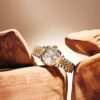
4. Andersen Genève Jumping Hours


Alongside world timers, Andersen Genève knows how to make a striking jumping hours watch. Created for the 10th annual Only Watch auction, this one-off Andersen Genève Jumping Hours finds elegance in restraint. The dial is composed of a 0.4mm cut of black jade and is left bare save for subtle branding and a jumping hour aperture at 12 o’clock and a minutes subdial at 6 o’clock. The exhibition caseback showcases the captivating in-house automatic movement which features a hand-guillochéd rose gold rotor.
Price: $POA
Model: Jumping Hours
Case size: 38mm
Movement: Frédéric Piguet 11.50 (automatic)
Water resistance: 3ATM
Power reserve: 72 hours
5. Chopard L.U.C Quattro Spirit 25


While the white grand feu enamel dial housing a jumping hour aperture and traditional minutes track around the periphery is striking in its simplicity, the highlight of the Chopard L.U.C Quattro Spirit 25 takes place within the rose gold case. The hand-wound in-house L.U.C 98.06-L movement utilises the manufacture’s exclusive Quattro technology and is equipped with four barrels that lend it up to eight days of power reserve; a rare feat for a jumping hours watch. The timepiece marks Chopard’s first foray into the complication and was released in a limited run of 100 examples.
Price: $89,900AUD
Model: L.U.C Quattro Spirit 25
Case size: 40mm
Movement: L.U.C 98.06-L (manually wound)
Water resistance: 3ATM
Power reserve: 192 hours (eight days)
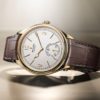
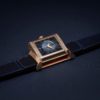
6. Bovet Fleurier Virtuoso V


A bona fide two-in-one, the Bovet Fleurier Virtuoso V sees a guilloché dial fitted with a central jumping hour aperture and retrograde minutes at 12 o’clock. It’s part of the manufacture’s Amedeo collection which is not only reversible, but can be transformed into a pocket watch or table clock. On the flip side, the dial displays the movement and atop it sits an off-centre dial displaying the hours and minutes in the traditional format.
Price: $127,998AUD
Model: Virtuoso V
Case size: 34.5mm
Movement: 13BM11AIHSMR (manually wound)
Water resistance: 3ATM
Power reserve: 120 hours (5 days)
7. IWC Tribute To Pallweber


This model pays tribute to Josef Pallweber, the young Austrian engineer who patented the jumping hour complication and is responsible for its commercialisation. The IWC Tribute To Pallweber remains faithful to the dial layout of the Schaffhausen manufacture’s early pocket watches, with digital jumping hours at 12 o’clock and jumping minutes in the centre, and a small seconds subdial at 6 o’clock. While power drain was an issue in jumping hour watches of the past, IWC has managed to circumvent this issue by separating the drive for the hours and minutes into two geartrains, each with a barrel of its own (connected by a trigger mechanism at the centre to ensure they’re in sync). This works without altering the flow of power in the main geartrain and allows for a 60-hour power reserve. The timepiece was released in a limited run in 2017.
Price: $36,600USD (approx. $53,460AUD)
Model: Tribute To Pallweber
Case size: 45mm
Movement: 94200 (manually wound)
Water resistance: 3ATM
Power reserve: 60 hours
8. De Bethune DB28 Digitale


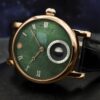
A contemporary take on the heritage complication, the De Bethune DB28 Digitale combines a digital jumping hour display with a 180° analogue minutes display and spherical moon phase. The dial is decorated with a hand-guilloché barleycorn motif as well as starry sky details. A modern take on classic functions.
Price: $POA
Model: DB28 Digitale
Case size: 45mm
Movement: DB2144 (manually wound)
Water resistance: 3ATM
Power reserve: 120 hours (five day)
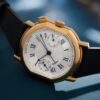
9. Franck Muller Crazy Hours


Perhaps the most striking and innovative use of the jumping hour complication, the Franck Muller Crazy Hours features a traditional hour and minute hand format on a decidedly untraditional dial. The hour numerals are placed in a seemingly haphazard fashion, with the hour hand jumping from one hour to the next in the correct order. Meanwhile, the minutes are indicated in the usual manner, based on the number that ‘should’ be on that position of the dial.
Price: from $26,466AUD
Model: Crazy Hours
Case size: varies
Movement: automatic
Water resistance: 3ATM
Power reserve: 42 hours

10. Mr Jones Number Cruncher


Look out, Big Ben! A satisfyingly unserious jumping hour watch, this release from British watch brand Mr Jones puts time in the clutches of a little monster. Designed by artist and character designer Onorio D’Epiro, the monster takes on Godzilla proportions, looming over the London skyline and happily devouring time. The jumping hours display can be seen between the monster’s fingertips (ready to be consumed), while the minutes are seen half-digested in his stomach. The monster stays hungry courtesy of the mechanical SeaGull TY2709 20 automatic movement. Spend you time before he eats it. Chomp!
Price: £295 (approx. $585AUD)
Model: Number Cruncher
Case size: 37mm
Movement: TY2709 (automatic)
Water resistance: 5ATM
Power reserve: 42 hours
11. Cartier Tank à Guichets


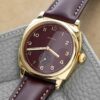
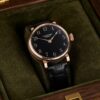
Unveiled at Watches & Wonders 2025, the Cartier Tank à Guichets was first introduced in 1928 and combines a mechanical movement with a digital time display. Sitting within the brand’s Privé collection—a favourite among collectors, it’s responsible for the limited-edition revival of archival timepieces like the Tonneau, Tank Normale, and Tortue—the Cartier Tank à Guichets pays homage to the original reference from 1928, placing the jumping hour and dragging minutes in a vertically oriented fashion, akin to a smiling cyclops.
Available in platinum, yellow gold, and rose gold cases measuring 37.6mm by 24.8mm, the timepieces feature the crown tucked away in the atypical position of 12 o’clock, so as not to disrupt the symmetry on the lateral sides. There’s also a more contemporary limited-edition take that sees a platinum case play host to angled, off-centre hours and minutes windows. Both the standard and limited-edition references have a vertically brushed finish on the case and are powered by the slim calibre 9755 MC, a manually wound movement.
Price: $83,000AUD (yellow gold, rose gold); $96,500AUD (platinum)
Model: Tank à Guichets
Case size: 37.6mm x 24.8mm
Movement: 9755 MC (manually wound)
Water resistance: 0ATM
Power reserve: approx. 48 hours
12. Christopher Ward C1 Jump Hour Mk V


Christopher Ward first introduced its jumping hour movement, a modified ETA with an instantaneous jump module, in 2015. A decade later and the British watch brand has brought back the movement to produce the new C1 Jump Hour Mk V. Sitting within the brand’s Atelier collection, the Christopher Ward C1 Jump Hour Mk V features a layered four-tiered dial with a stamped azzuré pattern on the base. The magnified aperture at 12 o’clock displays the jumping hour, the minutes track surrounding the periphery of the inner dial. The use of a transparent sapphire glass minute hand allows the instantaneous jump to be viewed every hour.
Price: $4610AUD
Model: C1 Jump Hour Mk V
Case size: 39mm
Movement: ETA 2824-2 with JJ01 module (automatic)
Water resistance: 3ATM
Power reserve: 38-41 hours
13. Chopard L.U.C Quattro Spirit 25 Straw Marquetry Edition


Sitting within the L.U.C Quattro Spirit 25 collection, this Straw Marquetry Edition has the same specifications (complete with Quattro technology and eight-day power reserve) as the white grand feu enamel iteration above. However, the use of straw marquetry finishing takes this special edition timepiece to the next level, with the shade of green chosen perfectly complementing the rose gold case surrounding it.
Price: $119,000AUD
Model: L.U.C Quattro Spirit 25 Straw Marquetry Edition
Case size: 40mm
Movement: L.U.C 98.06-L (manually wound)
Water resistance: 3ATM
Power reserve: 192 hours (eight days)
14. Louis Vuitton Tambour Convergence


A closed dial layout allows the jumping hour complication to shine, as evidenced in the Louis Vuitton Tambour Convergence (as well as the Cartier Tank à Guichets). The closed dial also has the ability to serve double duty as a canvas for métiers d’art, as seen in the platinum iteration which is adorned with all-over pavé set diamonds. However, it’s the rose gold iteration that’s the standout, with its unadorned polished surface recalling the smooth pebbled form of a pocket watch and drawing the eye to the sculpted aperture (or guichet) at 12 o’clock, which displays the jumping hours above the dragging minutes.
Price: $61,000AUD (rose gold); $111,000AUD (platinum)
Model: Tambour Convergence
Case size: 37mm
Movement: LFT MA01.01 (automatic)
Water resistance: 3ATM
Power reserve: 45 hours
15. Bremont Terra Nova Jump Hour


While most jump hour watches sit firmly on the dress watch side of things, the Bremont Terra Nova Jump Hour takes a rugged approach befitting of the brand’s tool watch origins. Inspired by early 20th-century guichet trench watches, the Bremont Terra Nova Jump Hour takes shape within a 38mm stainless steel cushion case with a closed dial with a vertically brushed finish. An aperture at 12 o’clock displays the jumping hours while the minutes are in a curved aperture at 6 o’clock. Directly in the centre is a circular compass-inspired sweeping seconds aperture.
Price: $7750AUD
Model: Terra Nova Jump Hour
Case size: 38mm
Movement: BC634 (automatic)
Water resistance: 3ATM
Power reserve: 56 hours
History of jumping hour watches
An early example of a clock with a digital style display can be found sitting above the stage of the Semper Opera House in Dresden. The Five Minute Clock sees the time updated—you guessed it—every five minutes, with the oversized numerals far easier to read than a conventional analogue clock. The Five Minute Clock was designed and built by master watchmaker Johann Christian Friedrich Gutkaes in the late 1930, with assistance from his (future) son-in-law Ferdinand Adolph Lange; founder of A. Lange & Söhne.
In the portable watch realm, the earliest recorded watch with an aperture display and jumping hour complication was a pocket watch made by French watchmaker Antoine Blondeau around 1830 for King Louis Philippe I.
However, the invention of the jumping hour watch as we know it today can be attributed to Austrian engineer Josef Pallweber, who patented the mechanism in 1883 at the age of 25. Pallweber granted the license to IWC, which began to manufacture Pallweber pocket watches from 1884 to the early 1980s, with records showing the manufacture produced and sold around 16,590 of these. These pocket watches had both digital jumping hour and jumping minute displays, making them easy to read and allowing for artwork to adorn the remainder of the dial.
The jumping hours complication made its wristwatch debut in the 1920s, coinciding with the Art Deco movement. Early adopters of the style included Audemars Piguet, Patek Philippe, Rolex, and Cartier.
Enjoyed this article on jumping hour watches? Check out our watch guides here; covering everything from the types of watch movements to watch styles and complications.
Words by T. Angel